The Whitney Biennial closes again, and the cycle of takes begins again with it. The selection is too political, or not political enough. The curatorial framework is rigorous, or pretentious. The included artists are emergent and overdue, or insufficiently established. The framing of the show as a snapshot of American art is unfortunate, or appropriate, depending on the writer.
What rarely receives sustained attention is the question that sits underneath all the others. The Biennial is treated as a kind of canonical instrument — a periodic measurement of what American art is doing — but the instrument itself has no obvious legitimacy. The Whitney is one museum among many, with one curatorial team selected by one director, working with one budget and one set of institutional constraints. The result is not a representative sample of anything. It is a representative sample of what one specific institution at one specific moment was willing and able to assemble.
The instrument and what it measures
The conflation of the Biennial with the wider American art scene is durable for understandable reasons. The Whitney is among the most prestigious American institutions for contemporary art. Its biennial format provides a periodic ritual around which the wider conversation organizes itself. The fact that the show is mounted at all is itself a kind of statement: an institutional commitment that other museums, increasingly cautious about contemporary programming, have largely abandoned.
But these conditions do not make the show what its reception assumes it is. A genuine snapshot of American art would require a wholly different methodology — one that took seriously the possibility that the most consequential work being made in any given period is not necessarily the work that the curatorial gaze, with all its specific commitments and blind spots, happens to find legible.
The artists who are not there
It is more useful, on a Biennial visit, to ask who is not in the show. This is harder than it sounds. The absences are not random; they reflect the specific aesthetic and intellectual preferences of the curatorial team, the institutional pressures that shape selection, the geographic distribution of the curators' attention, and the artists' own willingness or unwillingness to participate in the format.
Some categories of artist are reliably missing. Older artists whose work continues to evolve in significant ways but who are read as already-canonized rather than emerging. Mid-career artists whose work is too well-defined to fit the curatorial narrative being assembled. Artists working in regional centers without strong gallery representation to advocate for inclusion. Artists whose work is private, slow, or resistant to the kind of public framing that a Biennial selection requires.
The aesthetic of selection
The Biennial format has, over decades, developed an aesthetic of its own. The work that the format favors tends toward the legible, the timely, the photogenic in installation views. Work that requires sustained attention or that resists summary tends to be either omitted or installed in ways that reduce its specific demands.
This is not a criticism of the curatorial team, who work within real constraints. It is an observation about the format. A periodic large-scale group show, mounted under media attention, with budgets constrained by what is possible in a one-year selection timeline, will produce a specific kind of selection. The selection will accurately represent what that format can hold; it will not necessarily represent the wider field of practice.
The viewer's response
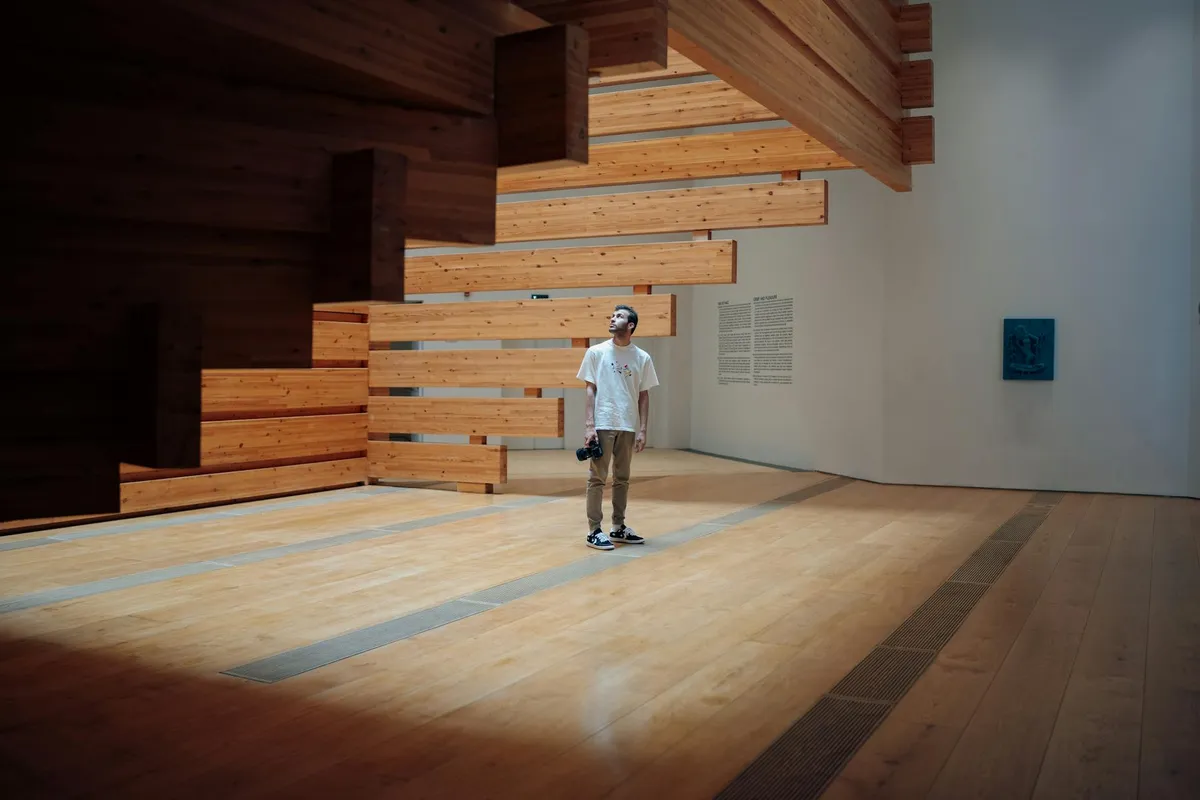
The appropriate response, for the patient viewer, is to take the Biennial as one specific occasion of looking — a chance to see work installed and adjacent to other work, with the friction and conversation that such installation produces. The wider question of what American art is doing is one the Biennial cannot answer. That question requires a different kind of attention: visits to smaller galleries and museums, studio visits, sustained engagement with individual artists' practices over time, attention to writing in journals that the institutional art world reads less.
The Biennial is useful as an occasion. It is misleading as an instrument. The persistent treatment of it as the latter is itself a phenomenon worth attending to — a sign of how much the contemporary art world depends on periodic ritual events to organize its sense of what is happening, even when the events themselves are insufficient to the task.
The closing observation
There is a kind of writing that takes the show on its own terms and considers what it accomplishes within those terms. That writing is genuinely useful. There is another kind of writing that asks larger questions about the format itself, and what it can and cannot do. That writing is also useful, and seems to appear less often. The Biennial cycle, treated as occasion rather than instrument, is the kind of slow public event that art writing should be willing to sit with — without the pressure to render a verdict in the days immediately following the opening.
The verdict that matters is not the take. It is what you carry away after the third or fourth visit, when the framing has fallen away and the individual works are still, or are not still, holding the attention they at first invited.