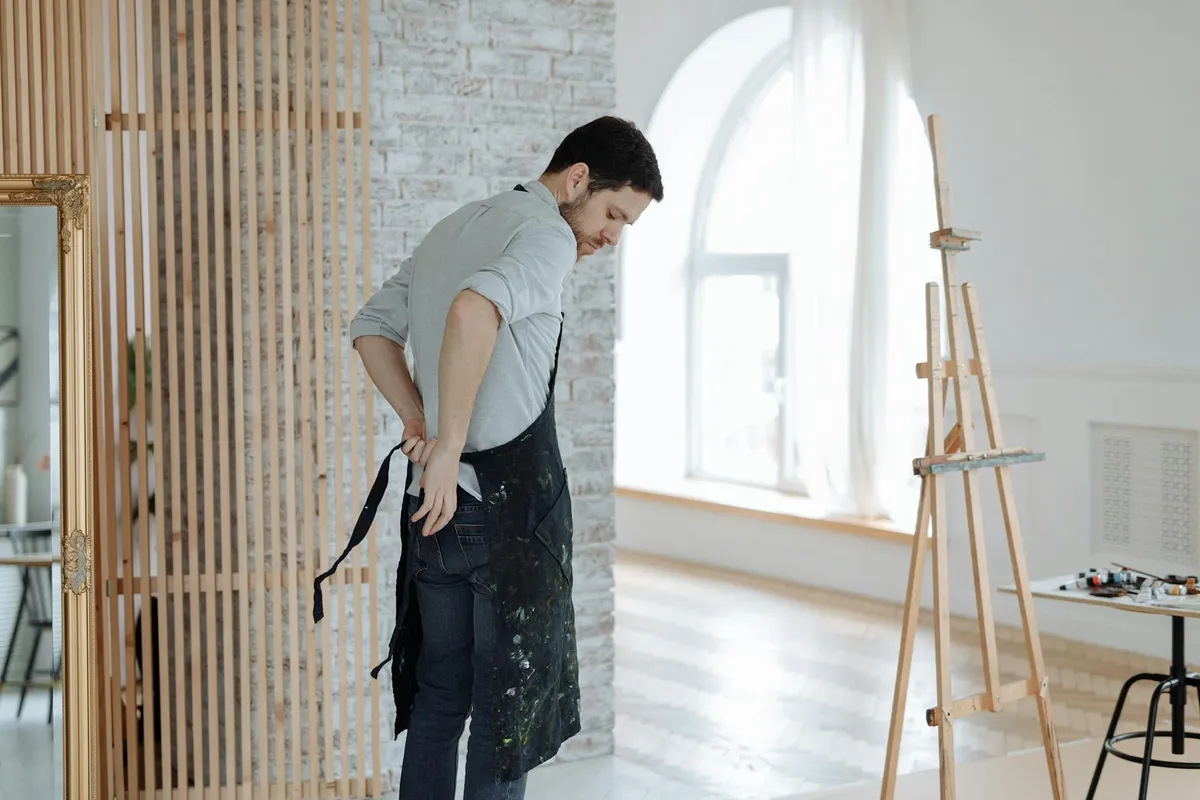
The studio is north-facing on the upper floor of a converted industrial building. The light is consistent, the temperature steady, the walls almost entirely white except for the patches behind the easels, where decades of pigment have accumulated in faint geological layers. There are paintings here in every stage. Some are stretched and underpainted. Some are nearly finished and propped against the wall, facing out. Some have been worked for years.
The painter is in her early sixties. She has exhibited regularly for thirty years. She is represented by one of the more thoughtful galleries in the city. She is, by any reasonable measure, an artist whose practice has long since stabilized. And yet, when she walks the studio, what she notices is the things still wrong with the paintings on the wall — the things that need reworking, the passages that have not yet found their resolution, the underpainting that is still showing through where it should not.
The reworking habit
"I would say half of any given painting was first painted three to five years ago," she says, standing in front of a canvas that has been on the same wall for at least four years across two studio visits. "There is a version of it that left here briefly for a show, and then came back. I worked on it again. Now it is what you see."
She does not consider any of the paintings finished. She uses the word "done" provisionally, and only because the practical world requires her to. A painting goes out for an exhibition; it is, for that purpose, done. If the gallery sells it, it is done in a more durable sense — but she has been known to ask collectors, occasionally, whether she could borrow back a painting for further work. She has done this perhaps a dozen times in her career.
The economy of the long reworking
The practice is not common, and there are reasons for that. Reworking a painting is, in commercial terms, a kind of subsidized work. Each hour spent reworking is an hour not spent on a new painting, and only new paintings — generally speaking — produce revenue. The galleries that support reworking artists tend to be either secure enough in their representation to absorb the slower production, or aligned with the artist on the principle that the work itself benefits.
"My gallery has been patient. I am aware that it is patience," she says. "I produce fewer paintings than the market would prefer. I am also aware that the reworking is part of what makes the work mine. The paintings would be different if I let them go sooner."
What the reworking does to the painting
The visible result of sustained reworking is a particular kind of surface — layered, with passages that read as decisions made at different times, with what conservators would call a complex stratigraphy. Underpainting shows through in some areas; in others, the surface is thick and worked, the result of repeated revisions over years. The paintings carry their history within them.
The effect is difficult to describe except by analogy. The paintings feel less like records of a moment and more like records of a sustained engagement — closer to writing that has been edited over many drafts than to writing that emerged in a single sitting. The reader of such writing senses the depth even without being able to name what it is they sense.
The discipline of returning
What sustains the practice is, in her account, less aesthetic conviction than habit. She has worked this way for so long that she no longer experiences the slow reworking as a deliberate choice. It is simply how the paintings get made.
"I do not believe in finished," she says. "I believe in handing it over, because that is what one does. But the painting is not finished. The painting is what I was willing to live with at the moment it left. If it came back, I would find more to do. I have proven this to myself many times."
The view from outside the practice
It is tempting to read this practice as resistance to the contemporary art world's demand for productivity, but the painter resists that framing. She does not see what she does as resistance. She sees it as the only way she knows how to work — and she is aware that other painters work differently, and that those ways are also legitimate.
What she would say, if pressed, is that the question of when a painting is finished is not one that the discipline of painting has settled, and that contemporary art's tendency to assume the question is settled — that paintings become finished at the moment they leave the studio — is itself a convention rather than a truth. Painters in earlier centuries reworked. Cézanne reworked obsessively. The question of where the edit stops is one of the open questions of the medium, and she would prefer not to foreclose it.
The slow gravity of the practice
What one takes away from a visit to this studio is the sense of a practice that has gravity — the gravity of years of attention, of returns made to the same work, of slow accretion. The paintings on the wall reward extended looking because they have themselves been looked at for years. They are, in a particular sense, finished objects of attention even if they are not finished paintings.
It is not a practice that scales. It does not produce the volume of work that a market expansion would require. But the paintings that emerge from the practice have something that more efficient practices struggle to achieve — a depth that reads as the depth of sustained looking, both from the painter and, eventually, from the viewer who agrees to give the painting the time it has spent waiting.