
The standard account of Édouard Manet places him at the threshold of modernism — the painter whose break with the academic tradition opened the path that Impressionism, Post-Impressionism, and the early twentieth century would walk. Olympia is the inaugural shock. The flat handling, the assertive gaze, the refusal of conventional pictorial depth: these become, in the standard reading, the founding moves of modernist painting.
The reading is not wrong, but it is partial. It treats Manet primarily as a historical position rather than as a painter, and in doing so it obscures the strangeness of the actual paintings — the way they negotiate their pictorial problems, the specific decisions visible in the brushwork, the attention to the difficult intersections of perceived light and painted surface that consumed him across his career.
The standard story
The standard story is told in any first-year survey of modern art. Manet, working in Paris in the 1860s and 1870s, broke with the academic conventions of his time by refusing pictorial depth, by handling paint flatly, by treating his subjects with a directness that the Salon found scandalous. Olympia, exhibited in 1865, became the foundational document — a Venus pose rendered with what contemporary critics described as a corpse-like flatness, with a black servant whose presence forces the viewer to acknowledge the social realities the Venus tradition obscured.
The standard story reads the subsequent development of modernism as a working-out of the implications of these decisions. Cézanne, Picasso, the entire trajectory of modernist flatness, would follow from the threshold Manet opened. The story has the elegance of all influential narratives; it accounts for a great deal of what happened.
What the story leaves out
What the story leaves out is most of what is interesting about Manet as a painter. The historical position is real, but the paintings are not principally interesting as historical positions. They are interesting as paintings — as objects that solve specific pictorial problems through specific means.
Consider the brushwork. Manet's handling is often described as flat, but the flatness is local. Particular passages — the way light catches a sleeve, the way a face moves between modeling and outline — are handled with attention to the difficult problem of how perceived light should be translated into paint. The flatness is not a principle. It is a strategy used in some passages, balanced against more conventionally modeled passages, with the overall composition negotiating between the two registers.
This is harder to see when one looks at Manet primarily through the lens of his historical position, because the historical position presses one to see the flatness as a programmatic statement rather than as a local pictorial decision. Standing in front of an actual Manet painting, the situation reads differently. The painting is constantly making local decisions about where to flatten and where not to, and the decisions are responsive to the specific perceptual problem each passage poses.
The subjects and what they were doing
The standard reading also treats Manet's subjects — the bourgeois life of Second Empire Paris, the figures at the racetrack and the café and the bar — as a kind of social commentary. The paintings record contemporary urban life in a way that the academic tradition had not.
This is also partly true. But the subjects are doing more than recording. They are providing Manet with specific pictorial problems that interest him. The Folies-Bergère bartender at the famous late painting is not principally a social statement, although the painting is also that. She is a difficult pictorial problem — a figure facing the viewer with a mirror behind her that reflects a scene that the figure herself cannot see, the whole composition negotiating between the planes of the bar surface, the figure, and the mirrored reflection.
What sustains Manet's engagement with these subjects is, in significant part, the pictorial problems they pose. The historical reading underplays this — treats the subjects as primarily about subject matter — and in doing so misses what the paintings are actually doing.
The handling of color
Manet's color handling, similarly, repays attention in ways that the standard historical reading underplays. The Manet color world is restrained — particularly compared to the Impressionists who followed him — but the restraint is itself a sustained pictorial decision. The blacks, in particular, are not flat blacks; they are blacks that have been worked for their specific qualities of weight and atmosphere. The greys and warm whites that Manet uses are often the most considered passages in the paintings.
To attend to the color is to begin to see Manet as the painter he actually was, rather than as the historical position he occupied. The paintings are not principally interesting because they opened the path to modernism. They are interesting because the specific decisions made within them are, individually and cumulatively, the decisions of a painter working at a high level on problems that interest him.
The strangeness of looking at the actual paintings
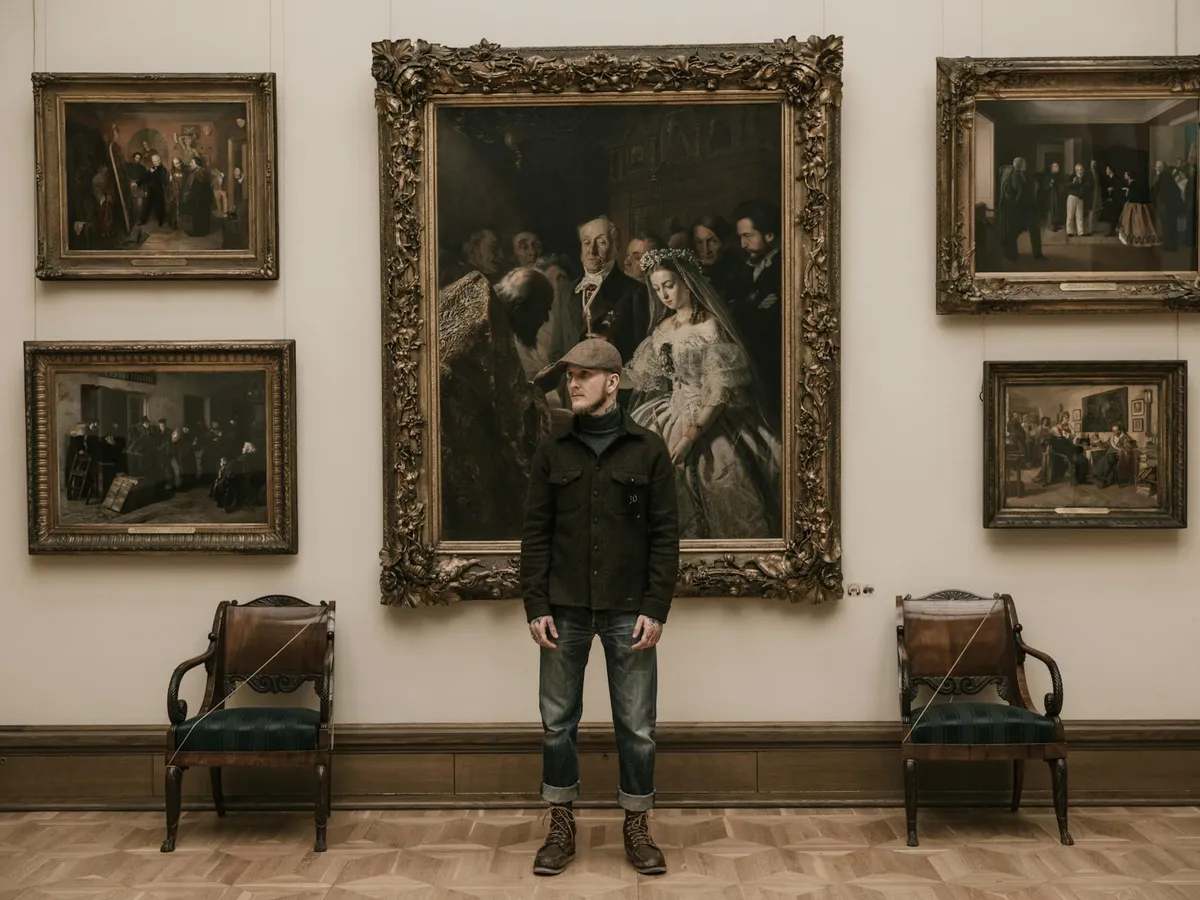
One way to recover the painter from the historical position is to spend time with the actual paintings. The Manet rooms at the d'Orsay, or the few Manets in major American collections, reward sustained looking in a way that the historical position predicts but does not specifically illuminate.
The paintings have, on extended viewing, qualities that the standard reading does not prepare one for. They are stranger than the reading suggests. They are more locally interested in pictorial problem-solving and less programmatically committed to flatness. They are more attentive to specific perceptual problems and less interested in general aesthetic statements.
The standard reading reduces this strangeness to a coherent historical narrative. The reduction has been productive — it has organized a century of subsequent painting — but it has come at the cost of letting the actual paintings speak for themselves.
The case for reconsideration
There is a kind of art-historical writing that does the work of reconsidering — that takes a figure whose historical position has been settled and asks what the actual practice was, behind the position. The work is slow and patient and does not produce the kind of dramatic revisionism that gets attention. It produces, instead, a richer sense of what the painters were actually doing.
Manet would benefit from such reconsideration. He has been a historical position for so long that the actual paintings have become slightly invisible behind the position. To bring the paintings back into view — to attend to the brushwork and the color and the specific pictorial decisions — is to recover something that the standard narrative has slowly obscured.
This is not a project of denying the historical position. The position is real. It is a project of insisting that the historical position is one thing the paintings did, among many things the paintings did, and that the other things are also worth attending to.